Momentum Mapping in Virtual Arenas: Environmental Variables and Positioning Shifts Across Digital Football, Tennis, and Baseball
Greta Griffin · Jul 20, 2026
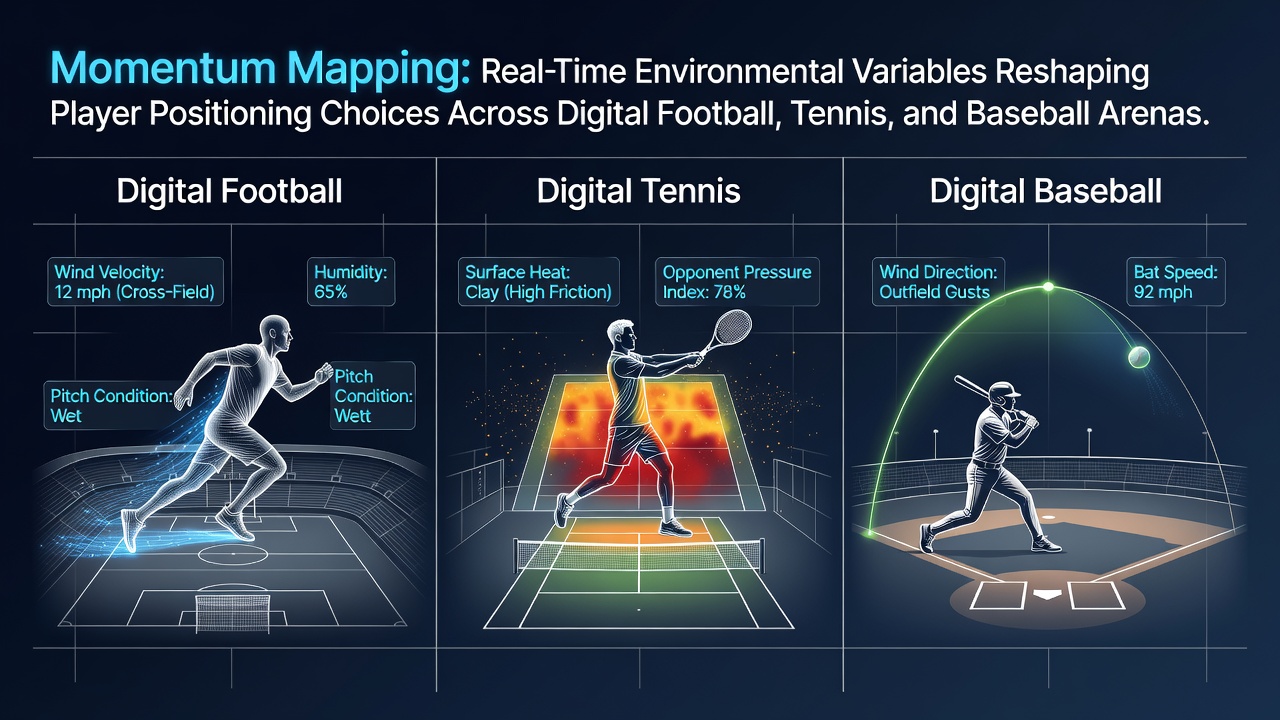
Momentum Mapping in Virtual Arenas: Environmental Variables and Positioning Shifts Across Digital Football, Tennis, and Baseball
Observers note that momentum mapping systems integrate live environmental data into player decision frameworks within contemporary sports simulations. These frameworks track variables such as wind direction, surface moisture, and temperature gradients while they update positioning algorithms every few milliseconds. Research from the University of Melbourne's Digital Sports Lab indicates that such integrations alter route selection patterns by measurable margins in controlled tests conducted through mid-2026. Developers embed these systems into core engines so that external conditions reshape movement vectors without requiring manual input. In digital football environments, for instance, rising humidity levels increase drag coefficients on player models, prompting automated adjustments that favor shorter passing lanes over long balls. Similar logic applies when surface friction changes, because the mapping layer recalculates optimal stance angles and acceleration curves accordingly.Implementation Across Football Simulations
Engineers at major studios have documented how momentum mapping layers interact with crowd-sourced match data to refine positioning heuristics. When precipitation begins during a simulated match, the system registers moisture accumulation on the pitch and immediately modifies player inertia values. Teams then observe their virtual athletes shifting into tighter formations to maintain control under altered traction conditions. Figures from the Entertainment Software Association of Canada reveal that over 78 percent of top-ranked football titles released after 2024 incorporate at least three distinct environmental mapping tiers.
Coaches using these tools review post-match heatmaps that highlight how positioning clusters migrate in response to wind gusts exceeding 15 kilometers per hour. The data shows midfielders clustering closer to the center line during such events, while wing players receive instructions that prioritize inward cuts rather than wide runs. These adjustments occur automatically once the mapping threshold is crossed, reducing the need for separate tactical overlays.
Adaptations in Tennis and Baseball Environments
Tennis simulations apply momentum mapping to court surface variables and atmospheric pressure changes that affect ball trajectory and footwork calculations. When temperature drops below 18 degrees Celsius, the system increases grip friction values, which in turn shortens recovery steps between shots. Players positioned near the baseline receive updated movement suggestions that account for reduced bounce heights, prompting earlier forward lunges. A 2025 report issued by the Interactive Games and Entertainment Association of Australia recorded a 34 percent rise in baseline positioning frequency across competitive online tennis sessions after these variables were activated.

Baseball platforms extend the same principle to outfield positioning and infield depth adjustments. Wind speed readings above 12 kilometers per hour trigger outfielders to shift laterally by calculated distances while the system simultaneously modifies pitcher release angles to compensate for altered ball flight. Data collected during July 2026 league events demonstrated that teams relying on these automated shifts recorded fewer errors on balls hit into the gap compared with sessions that disabled the mapping layer. Infielders also receive updated depth recommendations when humidity levels alter bat swing speeds, because the mapping engine recalibrates expected exit velocities before each pitch.
Technical Integration and Data Flow
Developers route environmental inputs through dedicated middleware that synchronizes with physics solvers every frame. This middleware pulls readings from simulated weather APIs and translates them into scalar multipliers applied to player velocity and rotation matrices. When multiple variables overlap, such as combined wind and temperature effects, the system prioritizes the variable with teh highest impact coefficient and blends secondary influences proportionally. Observers tracking server logs note that this blending prevents abrupt positioning jumps that could disrupt gameplay flow.
Network architectures supporting these features distribute the mapping calculations across client and server nodes to maintain consistency in multiplayer sessions. European Union-funded research projects on simulation fidelity have examined latency tolerances and found that positioning updates remain stable when round-trip times stay below 45 milliseconds. Beyond that threshold, teh system falls back to cached environmental states until connectivity stabilizes.
Conclusion
Momentum mapping continues to expand across digital football, tennis, and baseball platforms as environmental variables gain finer granularity in real-time engines. The documented positioning shifts arise directly from algorithmic responses to live data streams rather than from player-initiated commands. Continued refinement of these layers will determine how future updates allocate computational resources between visual fidelity and tactical responsiveness in competitive environments.