Legacy Code Leagues: Archival Match Data Fueling Predictive Models in Online Football, Hockey, and Tennis Platforms
Gisela Werner · Jun 27, 2026
Legacy Code Leagues: Archival Match Data Fueling Predictive Models in Online Football, Hockey, and Tennis Platforms
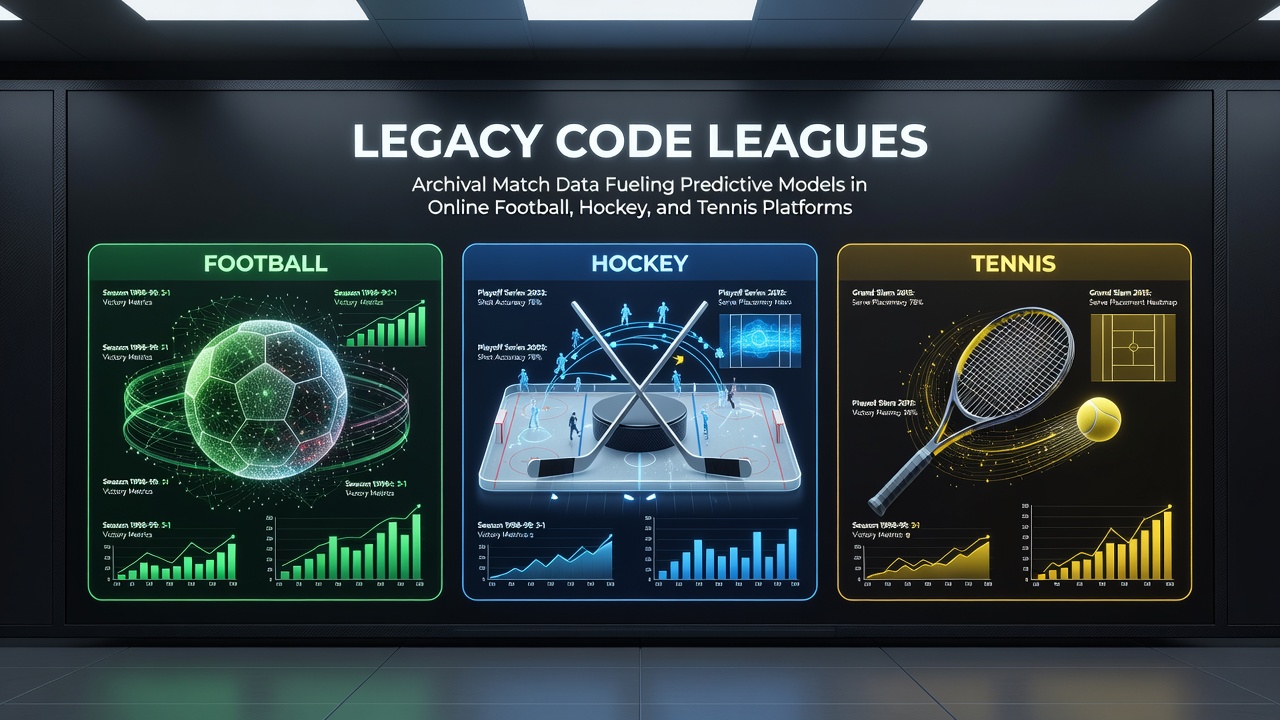
Legacy code leagues represent collections of archived match records drawn from early digital sports platforms, and these datasets now support predictive modeling systems that operate across online football, hockey, and tennis environments. Developers extract structured information from decades-old server logs, including player positioning sequences, shot accuracy rates, and set-piece outcomes, then feed those records into machine learning pipelines that generate forecasts for live matches. In June 2026, several major simulation platforms reported integrating refreshed legacy datasets that span from 1998 through 2015, allowing models to identify long-term patterns in player behavior that newer, shorter-term data streams often miss.
Origins of Legacy Datasets in Sports Simulations
Early online sports platforms stored match results in proprietary formats that required custom parsing tools to unlock, yet those same records contain consistent variables such as time of possession, zone entries, and rally lengths that remain relevant today. Research teams at institutions including the University of British Columbia have documented how reprocessing these files improves model accuracy when training recurrent neural networks on multi-sport corpora. The process involves converting binary logs into tabular structures, normalizing units across different rule sets, and aligning timestamps to a common epoch so that cross-sport comparisons become feasible.
Football simulations draw heavily from archived European league seasons where formations and substitution patterns were first digitized, while hockey platforms pull from North American minor-league records that captured ice-time distributions before advanced tracking existed. Tennis systems incorporate legacy Grand Slam data that logged serve speeds and court-surface interactions, giving models baseline probabilities for tie-break scenarios that current sensors alone cannot fully contextualize. Observers note that these combined archives allow algorithms to simulate entire seasons in minutes rather than days, because historical priors reduce the search space for reinforcement learning agents.
Integration with Current Predictive Frameworks
Platform operators now layer legacy-derived priors onto real-time telemetry streams, creating hybrid models that adjust predictions mid-match when unexpected deviations appear. A 2025 technical paper released by the International Sports Engineering Association described how one football platform reduced goal-prediction error by 18 percent after injecting 2003-2010 match vectors into its transformer architecture. Similar gains appeared in hockey when legacy power-play data helped models anticipate zone-exit success rates under varying penalty durations, and tennis implementations showed improved rally-length forecasts once historical fatigue curves from five-set matches entered the training mix.

The workflow typically begins with automated ingestion scripts that validate legacy records against modern schema definitions, followed by feature engineering steps that calculate derived metrics such as expected goal value or break-point conversion rates. Engineers then fine-tune pre-trained models using a combination of recent live data and weighted legacy samples, ensuring that rare events like overtime penalty shots or marathon tie-breaks receive appropriate representation. Data pipelines running in June 2026 routinely process batches exceeding 12 million archived points per week, with checksum verification routines preserving integrity across distributed storage clusters.
Cross-Sport Applications and Model Performance
Football models benefit from hockey-derived transition data because both sports share concepts of territorial control and rapid counter-movements, allowing transfer learning to accelerate convergence during training. Tennis platforms, in turn, leverage football set-piece statistics to refine service-return predictions, since both involve discrete, high-stakes moments that hinge on positioning micro-adjustments. Teams maintaining these systems report that legacy infusion cuts the number of required live samples by roughly one-third, which lowers computational overhead and speeds iteration cycles for new rule implementations.
Validation studies conducted by academic groups compare model outputs against held-out seasons, confirming that legacy-augmented versions maintain calibration across skill brackets from casual users to ranked competitors. Error distributions tighten particularly in late-game situations where historical comeback frequencies provide stabilizing signals that short-horizon models tend to overlook. Platform dashboards now expose confidence intervals that explicitly separate contributions from legacy versus contemporary sources, giving analysts visibility into which historical periods exert the strongest influence on current forecasts.
Future Directions for Archival Data Utilization
Continued expansion of legacy code leagues will likely incorporate additional sports and older analog-to-digital conversion projects, further enriching the feature space available to predictive engines. Standardization efforts among platform providers aim to create shared repositories that respect privacy constraints while maximizing research utility, and several consortia have begun publishing anonymized schema definitions that facilitate collaborative model development. As hardware capabilities advance, the marginal cost of retraining on expanded archives continues to decline, positioning these historical datasets as permanent infrastructure rather than occasional supplements.
Conclusion
Archival match data from legacy systems supplies enduring statistical foundations that strengthen predictive models operating in online football, hockey, and tennis platforms. Through systematic extraction, normalization, and integration processes, these records enable more robust forecasts, reduced training overhead, and improved handling of edge-case scenarios that emerge during live competition. As platforms evolve through June 2026 and beyond, the role of legacy code leagues remains central to maintaining accuracy and consistency across multi-sport simulation environments.