Fractured Fields: Terrain Deformation Mechanics Altering Plays in Online Soccer, Racing, and Baseball
Clara Krause · May 23, 2026
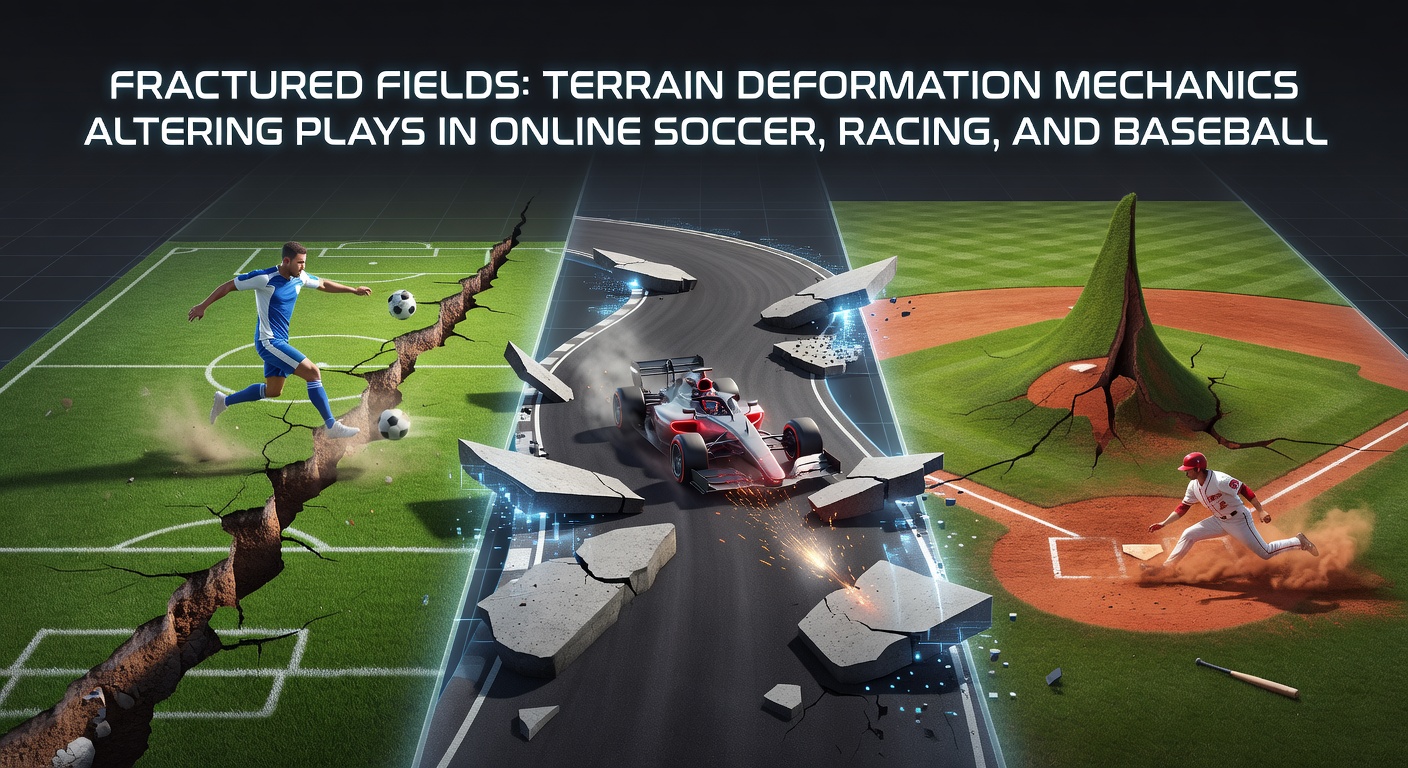
Fractured Fields: Terrain Deformation Mechanics Altering Plays in Online Soccer, Racing, and Baseball
Digital sports simulations continue to incorporate terrain deformation systems that respond dynamically to player actions, vehicle impacts, and environmental factors, and these mechanics directly influence strategy across soccer, racing, and baseball titles. Game engines track surface changes in real time, creating persistent alterations that carry over between plays or sessions in many multiplayer environments.
Core Mechanics Behind Surface Alteration
Physics calculations determine how much a field, track, or diamond shifts under repeated stress, while algorithms apply wear patterns based on movement speed, weight distribution, and frequency of contact. Soccer pitches develop compacted zones near goal mouths and penalty areas after sustained play, whereas racing circuits accumulate ruts along preferred racing lines that force drivers to adjust trajectories mid-race. Baseball diamonds register pitcher mounds that erode and infield dirt that kicks up into loose patches, each change feeding back into ball behavior and player footing.
Developers integrate these systems through layered height maps and material property updates that propagate across networked clients, ensuring every participant sees consistent terrain states. Studies from institutions such as the University of Waterloo indicate that deformation feedback loops require synchronized data packets to prevent desync issues during high-intensity moments like corner kicks or high-speed overtakes.
Impact on Soccer Gameplay Dynamics
In soccer simulations, muddy patches near the center circle slow ball roll and alter bounce angles, compelling teams to shift passing patterns toward the wings where the surface remains firmer. Goalkeepers adapt diving angles when goal areas develop depressions, and defenders exploit worn channels to channel attackers into predictable routes. Observers note that late-match fatigue compounds these effects because players tire faster on uneven ground, leading to increased turnovers in the final twenty minutes of simulated matches.
Racing Circuit Evolution Under Stress
Racing titles apply deformation primarily along apexes and braking zones where tire loads peak, creating grooves that reward precise line choice while punishing those who drift wide into fresh asphalt. Off-road variants see sand and gravel redistribution that forms berms and washouts, forcing racers to scout alternative paths after the opening laps. Data from industry reports published by the Entertainment Software Association shows that deformation layers in racing engines account for measurable differences in lap times once surfaces stabilize after roughly thirty percent of a race distance.
Vehicle setup choices gain additional weight when teams anticipate how evolving ruts will interact with suspension tuning and tire compounds over the course of an event.
Baseball Field Conditions and Tactical Adjustments
Baseball simulations register mound degradation that changes pitch release points and alters the trajectory of breaking balls as the landing zone softens. Infield dirt displacement affects ground ball speed and hop consistency, prompting infielders to shade closer to the baseline or adjust their ready positions. Outfield grass length and wear patterns influence ball carry, particularly when repeated slides carve temporary depressions that trap liners or slow rolling singles.

Coaches in online leagues often call for defensive realignments once specific zones show visible wear, and pitchers modify sequencing when they recognize that mound erosion favors certain pitch types over others. Research conducted at the University of Melbourne has examined how these incremental surface changes accumulate across innings and create compounding advantages for teams that monitor field state closely.
Technical Implementation and Network Considerations
Real-time deformation requires efficient client-server reconciliation to maintain fairness, particularly when multiple players interact with the same patch of terrain simultaneously. Compression techniques reduce the bandwidth needed to transmit height map deltas, while predictive algorithms smooth visual updates so participants experience seamless transitions rather than sudden surface jumps. By May 2026 several major simulation platforms had refined these systems further, incorporating machine learning models that forecast wear trajectories based on historical match data and player tendencies.
Strategic Adaptation Across Genres
Players and teams develop new heuristics once they internalize how terrain evolves within a given session or tournament bracket. Soccer squads favor possession-oriented styles on pristine surfaces yet switch to direct play when central lanes degrade, racing crews pre-load alternate setups that account for groove formation, and baseball managers adjust defensive alignments after the third inning based on visible dirt displacement patterns. These adaptations emerge organically through repeated exposure rather than explicit tutorials, rewarding observation and pattern recognition.
Conclusion
Terrain deformation mechanics have become a standard layer in online sports simulations, reshaping decision trees in soccer, racing, and baseball by turning static fields into evolving variables. Continued refinement of physics fidelity and network synchronization ensures these systems remain integral to competitive play, while ongoing academic and industry examination tracks their influence on both individual performance metrics and broader tactical trends.