Curveball Calculations: Modeling Break and Spin Effects in Digital Baseball, Tennis, and Soccer Encounters
Greta Griffin · Jul 9, 2026
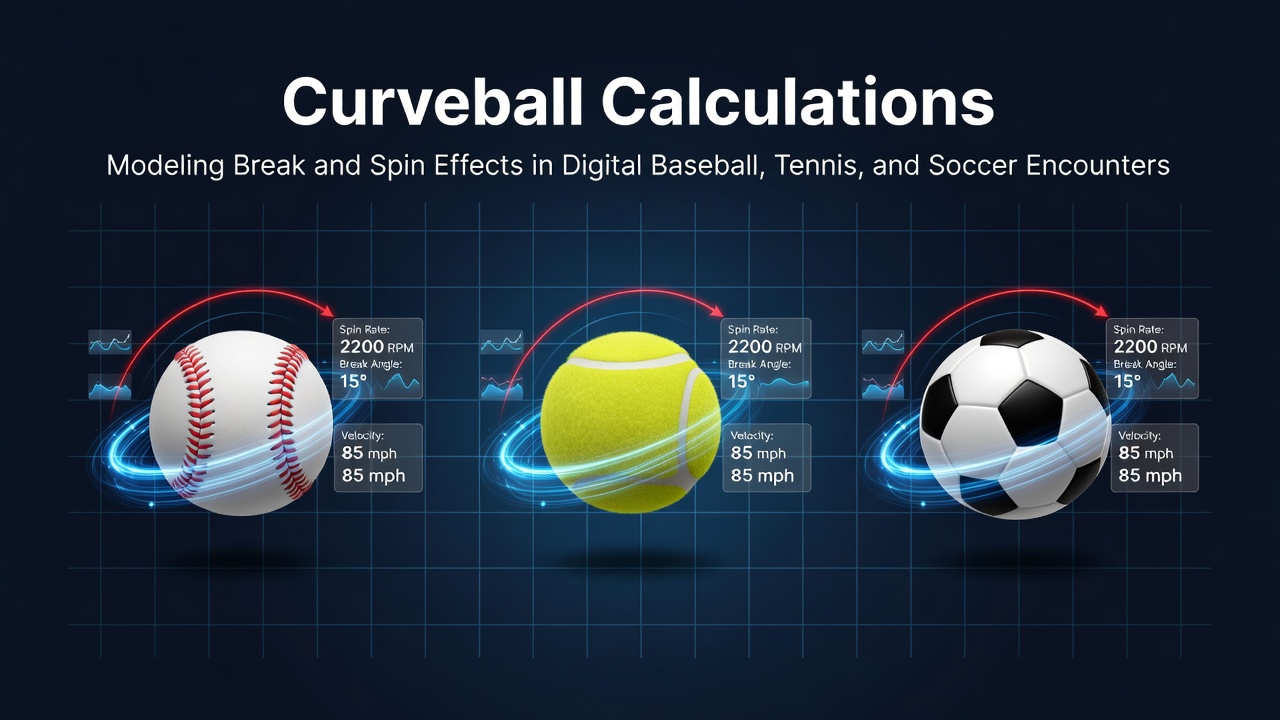
Curveball Calculations: Modeling Break and Spin Effects in Digital Baseball, Tennis, and Soccer Encounters
Digital sports simulations rely on precise mathematical frameworks to replicate the Magnus effect and related aerodynamic forces that produce ball break and spin in baseball, tennis, and soccer, with developers integrating differential equations for lift, drag, and torque into real-time physics engines that run at 60 frames per second or higher. These models draw from fluid dynamics principles first quantified in laboratory experiments during the early twentieth century and later refined through high-speed camera analysis of professional matches. Game studios adjust coefficients for air density, ball seam orientation, and surface texture so that virtual trajectories match observed outcomes across varying altitudes and humidity levels.
Core Aerodynamic Principles in Simulation Code
Researchers discovered that the primary force acting on a spinning sphere arises from asymmetric pressure distribution caused by the boundary layer separation, which programmers translate into vector calculations applied each physics tick; the lift force scales with the cross product of spin vector and velocity vector while drag opposes motion and grows nonlinearly with speed. In practice this means a baseball thrown with 2500 revolutions per minute of topspin will drop several centimeters more than a non-spinning pitch over 18 meters, a difference encoded through iterative numerical integration methods such as fourth-order Runge-Kutta solvers. Tennis balls exhibit additional complexity because their felt surface increases turbulence at lower speeds than smooth spheres, prompting developers to incorporate Reynolds number thresholds that trigger sudden drag crises observed in wind tunnel tests.
Baseball Pitch Modeling and Break Mechanics
Baseball simulations calculate release parameters including arm angle, grip pressure, and wrist snap to generate initial spin axes that determine whether a pitch breaks laterally, vertically, or in combinations such as the slider and curveball; data from motion-capture systems used by major league teams feed these values directly into game databases. Observers note that July 2026 updates in several flagship titles introduced variable seam orientation tracking, allowing the virtual ball to exhibit late movement when micro-variations in rotation axis align with the stitches. Pathfinding routines then propagate these forces through collision detection layers so that catchers receive accurate glove positioning cues based on projected arrival points calculated milliseconds ahead of contact.
Tennis Serve and Groundstroke Spin Dynamics
Tennis engines apply spin modifiers to racket face angle and swing path so that topspin shots dip sharply after the bounce while slice serves skid low and away from right-handed opponents; the coefficient of restitution between ball and court surface further modulates post-bounce velocity and spin retention. Studies published by the University of Melbourne sports engineering group in 2024 measured retention rates between 40 and 65 percent depending on surface type, values now replicated in tournament-licensed games through lookup tables updated each season. Players executing kick serves observe the ball jumping high to the backhand side because upward Magnus force persists through the bounce phase, an effect achieved by maintaining continuous torque calculations across the court boundary transition.
Soccer Free-Kick and Passing Bend Calculations
Soccer titles model the bending trajectory of free kicks by combining initial velocity vectors with side-spin components that generate lateral acceleration, while drag and lift coefficients vary with ball inflation pressure and panel orientation; programmers reference wind tunnel datasets collected by European football federations to calibrate these values. In July 2026 several multiplayer platforms synchronized their physics ticks with real-time weather APIs so that humidity and temperature shifts alter air density mid-match, producing subtle changes in bend radius that experienced players exploit during set pieces. Passing mechanics incorporate spin decay over distance so that long diagonal balls arrive with reduced swerve, matching empirical observations from professional matches tracked by optical systems deployed across major European leagues.
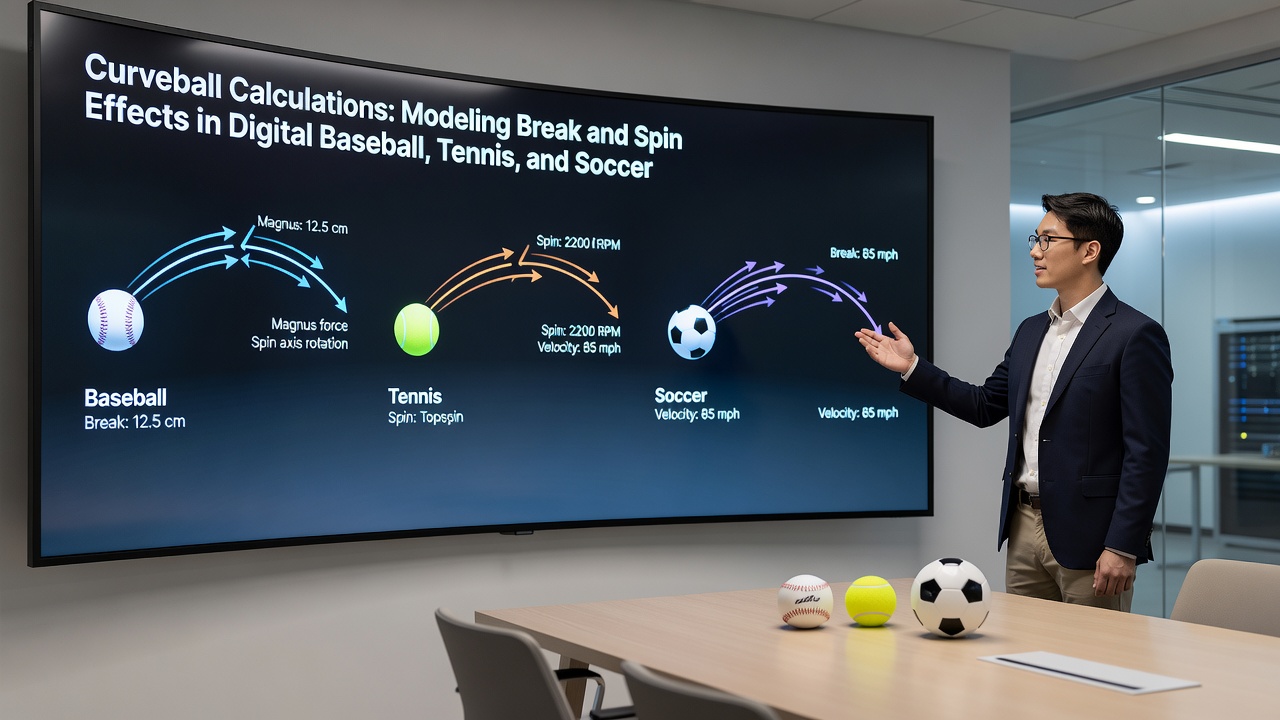
Computational Optimizations and Latency Mitigation
Real-time constraints force developers to simplify full Navier-Stokes fluid simulations into precomputed force tables indexed by velocity magnitude and spin rate, with selective ray marching used only near the goal line or home plate where precision matters most; this hybrid approach keeps CPU load manageable while preserving visual fidelity during replays. Networked sessions require deterministic floating-point arithmetic across clients so that all participants witness identical break behavior regardless of local hardware differences, a requirement achieved through fixed-point math libraries and synchronized random seeds for minor turbulence effects. Industry reports from the Entertainment Software Association indicate that simulation accuracy improvements correlate with higher retention rates in competitive modes because players trust the physics enough to attempt high-skill techniques such as the knuckleball or banana kick.
Validation Against Real-World Data Sets
Validation pipelines compare simulated trajectories against three-dimensional ball-tracking data collected by systems deployed in professional venues, adjusting parameters until mean squared error falls below established thresholds; one collaboration between Canadian university researchers and a major simulation studio produced open-access datasets covering over 50,000 pitches that continue to serve as benchmark material for new titles. Discrepancies often appear at extreme spin rates above 4000 revolutions per minute where boundary layer transition becomes chaotic, prompting ongoing refinement of stochastic turbulence models. Those who maintain these systems observe that small changes in the drag crisis threshold can shift predicted strike zones by several centimeters, directly affecting gameplay balance in online ranked matches.
Conclusion
Accurate modeling of break and spin effects continues to evolve through tighter integration of empirical data, improved numerical methods, and cross-platform synchronization techniques that deliver consistent experiences to millions of participants worldwide. As sensor technology and computational resources advance, digital representations of these aerodynamic phenomena grow closer to laboratory measurements, supporting training applications and spectator engagement alike. The underlying calculations remain grounded in established physics while adapting to hardware limitations and network realities that define online competition.